
Life Neuroscience
NeuroLife
Thu, Oct 22, 2026
[Archive]
Volume 3, Issue 1 (1-2025)
Neuroscience Updates 2025, 3(1): 1-5 |
Back to browse issues page




Download citation:
BibTeX | RIS | EndNote | Medlars | ProCite | Reference Manager | RefWorks
Send citation to:


BibTeX | RIS | EndNote | Medlars | ProCite | Reference Manager | RefWorks
Send citation to:
Moradikor N. Brain Health and Aging: How Nutrition Can Keep the Health. Neuroscience Updates 2025; 3 (1) :1-5
URL: http://neuroupdates.de/article-1-122-en.html
URL: http://neuroupdates.de/article-1-122-en.html


International Center for Neuroscience Research, Institute for Intelligent Research, Tbilisi, Georgia
Abstract: (2292 Views)
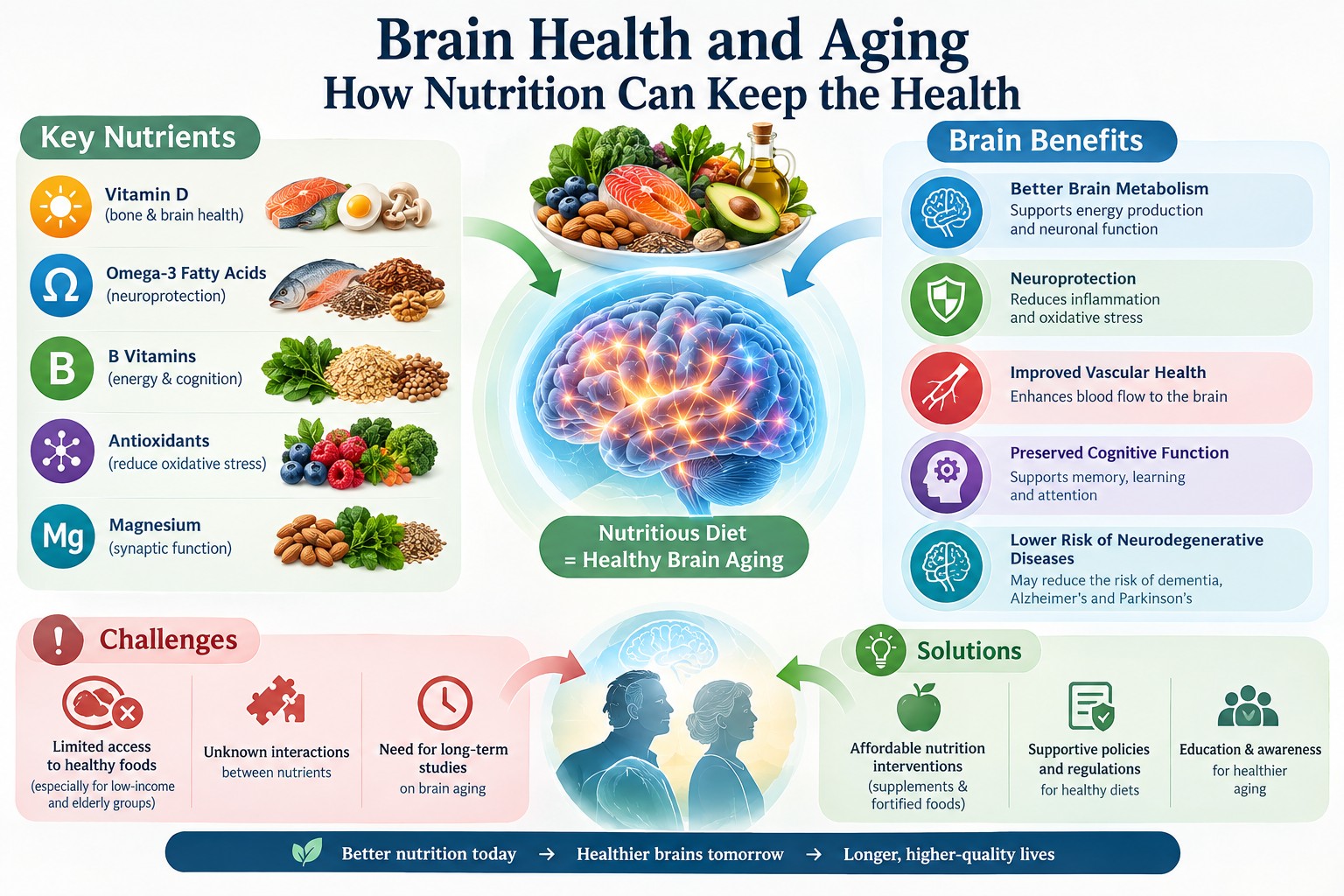
The purpose of this editorial is to examine the critical role that nutrition plays in preserving brain function and preventing aging-related cognitive decline. Neurodegenerative disorders including dementia, Parkinson's disease, and Alzheimer's disease are on the rise as the world's population ages, underscoring the necessity of efficient preventive measures. Vitamin D, omega-3 fatty acids, B vitamins, antioxidants, and magnesium are among the essential nutrients that have been shown to improve brain function, lower inflammation, and prevent dementia. The impacts of these nutrients on brain metabolism, neuroprotection, and vascular health are highlighted in the paper's discussion of how they support cognitive health. It also draws attention to the difficulties in obtaining foods that improve cognitive function, especially for low-income and elderly groups where food availability and dietary practices may be restricted. Furthermore, nothing is known about the long-term effects of these nutrients on brain aging and how they interact. To completely comprehend the connection between nutrition and cognitive decline, future research should concentrate on extensive, long-term investigations. Furthermore, creating reasonably priced nutritional interventions—like supplements and fortified foods—can contribute to ensuring that everyone has access to brain-healthy nutrition. We can support healthier aging and enhance general quality of life by increasing knowledge and enacting laws that encourage healthier eating habits.
Graphical Abstract:
Reseach Highlights:
- Aging is a major risk factor for neurodegenerative diseases.
- Healthy aging relies on nutrient-rich dietary patterns and smart eating habits.
- Functional foods are a promising approach to preventing age-related diseases.
- Vitamin D, omega-3 fatty acids, and B vitamins are among the essential nutrients for brain function.
Type of Study: Editorial Commentary |
Subject:
Basic Neuroscience
Received: 2024/12/10 | Accepted: 2025/01/23 | Published: 2025/01/25
Received: 2024/12/10 | Accepted: 2025/01/23 | Published: 2025/01/25
References
1. Brito D, Esteves F, Rajado A, Silva N, Araújo I, Bragança J, et al. Assessing cognitive decline in the aging brain: lessons from rodent and human studies. npj Aging. 2023;9(1):23. [DOI:10.1038/s41514-023-00120-6] [PMID] [PMCID]
2. Banks WA, Reed MJ, Logsdon AF, Rhea EM, Erickson MA. Healthy aging and the blood-brain barrier. Nature aging. 2021;1(3):243-54. [DOI:10.1038/s43587-021-00043-5] [PMID] [PMCID]
3. MacDonald ME, Pike GB. MRI of healthy brain aging: A review. NMR in Biomedicine. 2021;34(9):e4564. [DOI:10.1002/nbm.4564] [PMID]
4. Alcazar J, Aagaard P, Haddock B, Kamper RS, Hansen SK, Prescott E, et al. Age-and sex-specific changes in lower-limb muscle power throughout the lifespan. The Journals of Gerontology: Series A. 2020;75(7):1369-78. [DOI:10.1093/gerona/glaa013] [PMID]
5. Fekete M, Fazekas-Pongor V, Balazs P, Tarantini S, Nemeth AN, Varga JT. Role of new digital technologies and telemedicine in pulmonary rehabilitation: Smart devices in the treatment of chronic respiratory diseases. Wiener Klinische Wochenschrift. 2021;133(21):1201-7. [DOI:10.1007/s00508-021-01930-y] [PMID] [PMCID]
6. Ayo-Martin O, García-García J, Hernández-Fernández F, Gómez-Hontanilla M, Gómez-Fernández I, Andrés-Fernández C, et al. Cerebral hemodynamics in obesity: Relationship with sex, age, and adipokines in a cohort-based study. Geroscience. 2021;43(3):1465-79. [DOI:10.1007/s11357-020-00313-x] [PMID] [PMCID]
7. Kuzuya M. Nutritional status related to poor health outcomes in older people: Which is better, obese or lean? Geriatrics & Gerontology International. 2021;21(1):5-13. [DOI:10.1111/ggi.14088] [PMID]
8. Cole JH, Marioni RE, Harris SE, Deary IJ. Brain age and other bodily 'ages': implications for neuropsychiatry. Molecular psychiatry. 2019;24(2):266-81. [DOI:10.1038/s41380-018-0098-1] [PMID] [PMCID]
9. Duque G, Al Saedi A, Rivas D, Miard S, Ferland G, Picard F, et al. Differential effects of long-term caloric restriction and dietary protein source on bone and marrow fat of the aging rat. The Journals of Gerontology: Series A. 2020;75(11):2031-6. [DOI:10.1093/gerona/glaa093] [PMID] [PMCID]
10. Fekete M, Szarvas Z, Fazekas-Pongor V, Feher A, Csipo T, Forrai J, et al. Nutrition strategies promoting healthy aging: from improvement of cardiovascular and brain health to prevention of age-associated diseases. Nutrients. 2022;15(1):47. [DOI:10.3390/nu15010047] [PMID] [PMCID]
11. Ros M, Carrascosa JM. Current nutritional and pharmacological anti-aging interventions. Biochimica et Biophysica Acta (BBA)-Molecular Basis of Disease. 2020;1866(3):165612. [DOI:10.1016/j.bbadis.2019.165612] [PMID]
12. Oikawa SY, Brisbois TD, van Loon LJ, Rollo I. Eat like an athlete: insights of sports nutrition science to support active aging in healthy older adults. Geroscience. 2021:1-11. [DOI:10.1007/s11357-021-00419-w] [PMID] [PMCID]
13. Scarmeas N, Stern Y, Mayeux R, Manly JJ, Schupf N, Luchsinger JA. Mediterranean diet and mild cognitive impairment. Archives of neurology. 2009;66(2):216-25. [DOI:10.1001/archneurol.2008.536] [PMID] [PMCID]
14. Boulos C, Yaghi N, El Hayeck R, Heraoui GN, Fakhoury-Sayegh N. Nutritional risk factors, microbiota and Parkinson's disease: what is the current evidence? Nutrients. 2019;11(8):1896. [DOI:10.3390/nu11081896] [PMID] [PMCID]
15. Jennings A, Cunnane SC, Minihane AM. Can nutrition support healthy cognitive ageing and reduce dementia risk? bmj. 2020;369. [DOI:10.1136/bmj.m2269] [PMID] [PMCID]
16. Raichle ME. Two views of brain function. Trends in cognitive sciences. 2010;14(4):180-90. [DOI:10.1016/j.tics.2010.01.008] [PMID]
17. Spector R. Vitamin transport diseases of brain: focus on folates, thiamine and riboflavin. Brain Disord Ther. 2014;3(2):1. [DOI:10.4172/2168-975X.1000120]
18. Spector R, Johanson CE. Vitamin transport and homeostasis in mammalian brain: focus on Vitamins B and E. Journal of neurochemistry. 2007;103(2):425-38. [DOI:10.1111/j.1471-4159.2007.04773.x] [PMID]
19. Kerns JC, Arundel C, Chawla LS. Thiamin deficiency in people with obesity. Advances in nutrition. 2015;6(2):147-53. [DOI:10.3945/an.114.007526] [PMID] [PMCID]
20. Rucker RB, Bauerly K. Pantothenic acid. Handbook of vitamins. 2013;5.
21. Micek A, Godos J, Brzostek T, Gniadek A, Favari C, Mena P, et al. Dietary phytoestrogens and biomarkers of their intake in relation to cancer survival and recurrence: a comprehensive systematic review with meta-analysis. Nutrition Reviews. 2021;79(1):42-65. [DOI:10.1093/nutrit/nuaa043] [PMID]
22. Caruso G, Torrisi SA, Mogavero MP, Currenti W, Castellano S, Godos J, et al. Polyphenols and neuroprotection: Therapeutic implications for cognitive decline. Pharmacology & Therapeutics. 2022;232:108013. [DOI:10.1016/j.pharmthera.2021.108013] [PMID]
23. Assisi A, Banzi R, Buonocore C, Capasso F, Di Muzio V, Michelacci F, et al. Fish oil and mental health: the role of n-3 long-chain polyunsaturated fatty acids in cognitive development and neurological disorders. International clinical psychopharmacology. 2006;21(6):319-36. [DOI:10.1097/01.yic.0000224790.98534.11] [PMID]
24. Youdim KA, Martin A, Joseph JA. Essential fatty acids and the brain: possible health implications. International journal of developmental neuroscience. 2000;18(4-5):383-99. [DOI:10.1016/S0736-5748(00)00013-7] [PMID]
25. Snowden SG, Ebshiana AA, Hye A, An Y, Pletnikova O, O'Brien R, et al. Association between fatty acid metabolism in the brain and Alzheimer disease neuropathology and cognitive performance: A nontargeted metabolomic study. PLoS medicine. 2017;14(3):e1002266. [DOI:10.1371/journal.pmed.1002266] [PMID] [PMCID]
26. Lin P-Y, Cheng C, Satyanarayanan SK, Chiu L-T, Chien Y-C, Chuu C-P, et al. Omega-3 fatty acids and blood-based biomarkers in Alzheimer's disease and mild cognitive impairment: A randomized placebo-controlled trial. Brain, behavior, and immunity. 2022;99:289-98. [DOI:10.1016/j.bbi.2021.10.014] [PMID]
27. Solfrizzi V, Panza F, Frisardi V, Seripa D, Logroscino G, Imbimbo BP, et al. Diet and Alzheimer's disease risk factors or prevention: the current evidence. Expert review of neurotherapeutics. 2011;11(5):677-708. [DOI:10.1586/ern.11.56] [PMID]
28. Otaegui-Arrazola A, Amiano P, Elbusto A, Urdaneta E, Martínez-Lage P. Diet, cognition, and Alzheimer's disease: food for thought. European journal of nutrition. 2014;53:1-23. [DOI:10.1007/s00394-013-0561-3] [PMID]
29. Cherbuin N, Kumar R, Sachdev PS, Anstey KJ. Dietary mineral intake and risk of mild cognitive impairment: the PATH through life project. Frontiers in aging neuroscience. 2014;6:4. [DOI:10.3389/fnagi.2014.00004] [PMID] [PMCID]
30. Anjum I, Jaffery SS, Fayyaz M, Samoo Z, Anjum S. The role of vitamin D in brain health: a mini literature review. Cureus. 2018;10(7). [DOI:10.7759/cureus.2960]
31. Gáll Z, Székely O. Role of vitamin D in cognitive dysfunction: new molecular concepts and discrepancies between animal and human findings. Nutrients. 2021;13(11):3672. [DOI:10.3390/nu13113672] [PMID] [PMCID]
32. Chauhan A, Chauhan V. Beneficial effects of walnuts on cognition and brain health. Nutrients. 2020;12(2):550. [DOI:10.3390/nu12020550] [PMID] [PMCID]
33. Ros E, Sala-Vila A. Nuts and brain health: Cognition, depression, and neurodegenerative diseases. Health benefits of nuts and dried fruits: CRC Press; 2020. p. 261-88. [DOI:10.1201/9781315173337-12]
34. Paranthaman S, Palraj P. Bioactive Compounds of Algae: Potential Neuroprotective Agents in Neurodegenerative Disorders. Neuroprotective Effects of Phytochemicals in Brain Ageing: Springer; 2024. p. 257-88. [DOI:10.1007/978-981-99-7269-2_12]
35. Yoo C, Maury J, Gonzalez DE, Ko J, Xing D, Jenkins V, et al. Effects of Supplementation with a Microalgae Extract from Phaeodactylum tricornutum Containing Fucoxanthin on Cognition and Markers of Health in Older Individuals with Perceptions of Cognitive Decline. Nutrients. 2024;16(17):2999. [DOI:10.3390/nu16172999] [PMID] [PMCID]
Send email to the article author
| Rights and permissions | |
 |
This work is licensed under a Creative Commons Attribution-NonCommercial 4.0 International License. |


.png)
