
Life Neuroscience
NeuroLife
Fri, Oct 23, 2026
[Archive]
Volume 3, Issue 1 (1-2025)
Neuroscience Updates 2025, 3(1): 21-35 |
Back to browse issues page




Download citation:
BibTeX | RIS | EndNote | Medlars | ProCite | Reference Manager | RefWorks
Send citation to:


BibTeX | RIS | EndNote | Medlars | ProCite | Reference Manager | RefWorks
Send citation to:
Jaber M, Khalid H, Ansari S, Banafa A, Elagib H, Ekvtimishvili E. Microsurgical Clipping versus Endovascular Coiling in Ruptured and Unruptured Anterior Circulation Aneurysms: A Literature Review. Neuroscience Updates 2025; 3 (1) :21-35
URL: http://neuroupdates.de/article-1-124-en.html
URL: http://neuroupdates.de/article-1-124-en.html
Marwan Jaber *1 

 , Hassan Khalid2 , Sarah Ansari1 , Ali Banafa1 , Haneen Elagib3 , Erekle Ekvtimishvili4
, Hassan Khalid2 , Sarah Ansari1 , Ali Banafa1 , Haneen Elagib3 , Erekle Ekvtimishvili4
1- School of Health Sciences, University of Georgia, Tbilisi, Georgia
2- Faculty of Medicine, Tbilisi State Medical University, Tbilisi, Georgia
3- Faculty of Medicine, Georgian American University, Tbilisi, Georgia
4- Endovascular Neurosurgery Department, High Technology Medical Center, University Clinic, Tbilisi, Georgia
2- Faculty of Medicine, Tbilisi State Medical University, Tbilisi, Georgia
3- Faculty of Medicine, Georgian American University, Tbilisi, Georgia
4- Endovascular Neurosurgery Department, High Technology Medical Center, University Clinic, Tbilisi, Georgia
Abstract: (2413 Views)
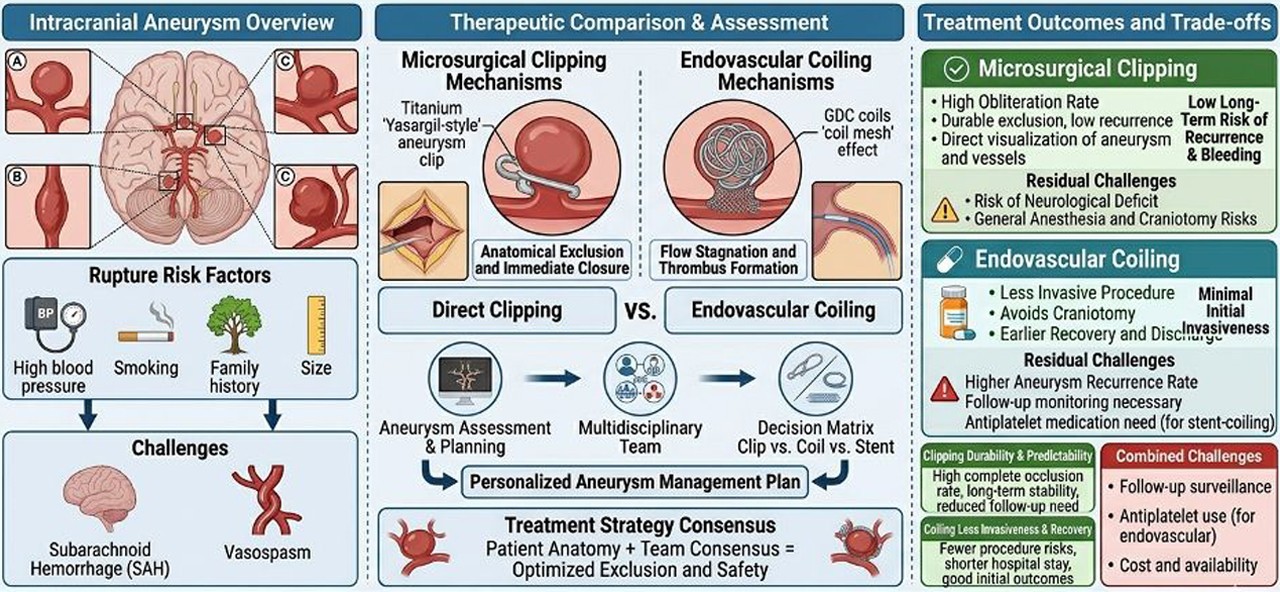
Anterior circulation aneurysms are abnormal dilations of the vessel wall of the anterior circulation. Rupture can result in subarachnoid hemorrhage, cerebral infarction, hydrocephalus, motor and cognitive impairment. Microsurgical clipping (MC) is a traditional treatment modality, particularly for patients with complex neck morphology. Endovascular coiling (EC), the newer approach, offers less invasiveness with shorter recovery time. PubMed and Google Scholar were searched for articles that compare between MC and EC, using keywords such as “microsurgical clipping”, “endovascular coiling”, and “anterior circulation aneurysms”. Analysis was done from 23 studies, focusing on different anatomical subgroups and different outcomes. Out of the 23 studies, MC showed superior angiographic durability across all anterior circulation subgroups, achieving higher immediate complete occlusion rates from 78.9% to 96.4%, compared to EC (18.8% to 44.4%), which translates to a higher risk of aneurysm regrowth and necessitated retreatment for EC (13.2% in u-AC vs 1.4%). EC for unruptured lesions also carried a higher risk of asymptomatic thromboembolic events (24.5 vs 2%). Advanced endovascular strategies, such as flow diversion and web devices, which are designed to improve durability and safety, are not represented in this study. The choice between MC and EC must balance the long-term durability advantage of clipping against the lower immediate risk of neurocognitive-critical ischemic injury offered by coiling in certain locations. The choice of strategy should remain individualized, and future research should focus on more dedicated randomized clinical trials, and compare modern endovascular modalities against MC.
Keywords: Aneurysm, Anterior circulation, Microsurgery, Endovascular treatment, Middle cerebral artery, Ruptured and unruptured aneurysms
Graphical Abstract:
Reseach Highlights:
- Microsurgical clipping (MC) consistently demonstrated superior angiographic occlusion rates compared to endovascular coiling (EC).
- Aneurysms treated with endovascular coiling showed higher rate of recurrence, thereby higher rates of retreatment.
- MC demonstrated a vital survival advantage compared with EC in ruptured aneurysms across different locations.
- Endovascular coiling showed better results in terms of intracranial infection and delayed cerebral ischemia.
Type of Study: Review Article |
Subject:
Clinical Neuroscience
Received: 2025/03/10 | Accepted: 2025/05/15 | Published: 2025/05/20
Received: 2025/03/10 | Accepted: 2025/05/15 | Published: 2025/05/20
References
1. Júnior, J. R., Telles, J. P. M., da Silva, S. A., de Holanda, L. F., Munhoz, S. P., de Souza, B. B., & Teixeira, M. J. (2019). Epidemiological analysis of 1404 patients with intracranial aneurysm followed in a single Brazilian institution. Surgical Neurology International, 10, 106.
https://doi.org/10.25259/SNI_443_2019 [DOI:10.25259/sni_443_2019] [PMID] [PMCID]
2. Mohammad, F., Horiguchi, T., Mizutani, K., & Yoshida, K. (2020). Clipping versus coiling in unruptured anterior cerebral circulation aneurysms. Surgical Neurology International, 11, 50.
https://doi.org/10.25259/SNI_1_2020 [DOI:10.25259/sni_1_2020] [PMID] [PMCID]
3. Rilianto, B., Yuwono, A., & Saharso, D. (2023). Clinical and morphological factors associated with ruptured anterior communicating artery aneurysms. International Journal of Surgery Case Reports, 106, 108006.
https://doi.org/10.2147/VHRM.S415213 [DOI:10.2147/vhrm.s415213] [PMID] [PMCID]
4. Diaz, F. G., Fessler, R. D., Velardo, B., Kennedy, C., & Wilner, H. (1994). Anterior circulation aneurysms: Surgical perspectives. Surgical Neurology International, 41(1), 51-58. [DOI:10.1016/0967-5868(94)90062-0] [PMID]
5. Li, Z., Gao, B. L., Zhang, X., & Zhang, B. (2021). Ruptured middle cerebral artery aneurysm with intrasylvian hematoma: Clinical presentation and complications. Polish Journal of Radiology, 86, e1-e5. [DOI:10.5114/pjr.2021.104822]
6. Bijlenga, P., Ebeling, C., Jaegersberg, M., Schaller, K., Skiebe, C., Corniola, A., ... & Schaller, C. (2013). Risk of rupture of small anterior communicating artery aneurysms is similar to posterior circulation aneurysms. Stroke, 44(10), 2750-2755.
https://doi.org/10.1161/STROKEAHA.113.001667 [DOI:10.1161/strokeaha.113.001667] [PMID]
7. Liu, J., Xing, H., Chen, Y., Zhang, J., Cheng, Z., Wang, X., ... & Feng, X. (2022). Rupture risk assessment for anterior communicating artery aneurysms using decision tree modeling. Frontiers in Cardiovascular Medicine, 9, 900647. [DOI:10.3389/fcvm.2022.900647] [PMID] [PMCID]
8. Berro, D. H., L'Allinec, V., Pasco-Papon, A., Barbier, C., Faure, S., & Nguyen, J. P. (2020). Clip-first policy versus coil-first policy for the exclusion of middle cerebral artery aneurysms. Journal of 9. Neurosurgery, 133, 1124-1131.
https://doi.org/10.3171/2019.5.JNS19373 [DOI:10.3171/2019.5.jns19373] [PMID]
9. Take, Y., Kamide, T., Kikkawa, Y., Kuriki, H., Tsutsumi, K., & Kawase, T. (2021). Current treatment options and prognostic factors for ruptured distal anterior cerebral artery aneurysms. Surgical Neurology International, 12, 171.
https://doi.org/10.25259/SNI_223_2021 [DOI:10.25259/sni_223_2021] [PMID] [PMCID]
10. Pei, Y., Cai, J., Zhang, Q., Xu, G., & Gao, Y. (2021). Risk factors for rupture of anterior circulation intracranial aneurysms. Frontiers in Neurology, 12, 666843. [DOI:10.3389/fneur.2021.693549] [PMID] [PMCID]
11. Kim, J. H., Lee, K. Y., Ha, S. W., & Suh, S. H. (2021). Prevalence of unruptured intracranial aneurysms: A single center experience using 3T brain MR angiography. Neurointervention, 16(2), 117-121. [DOI:10.5469/neuroint.2021.00024] [PMID] [PMCID]
12. Sturiale, C. L., Scerrati, A., Ricciardi, L., Auricchio, A. M., Norri, N., Gessi, G., ... & Olivi, A. (2022). Clipping versus coiling for treatment of middle cerebral artery aneurysms: A retrospective Italian multicenter experience. Neurosurgical Review, 45(4), 3179-3191. [DOI:10.1007/s10143-022-01822-3] [PMID] [PMCID]
13. Falzon, A., Xuereb, C., Grech, R., & Bonello, K. (2024). Management of anterior choroidal artery aneurysms: A retrospective cohort study. Brain Sciences, 15(1), 5. [DOI:10.3390/brainsci15010005] [PMID] [PMCID]
14. Sajid, T., Firdose, S., Hussain, S., Yaqoob, U., Wani, A. A., & Kirmani, A. R. (2024). Surgical outcome of clipping in anterior circulation aneurysms. Journal of Neurosciences in Rural Practice, 15(2), 256-262.
https://doi.org/10.12669/pjms.40.12(PINS).11119 [DOI:10.12669/pjms.40.12(pins).11119] [PMID] [PMCID]
15. Kim, B. M., Kim, D. I., Shin, Y. S., Shin, H. S., Park, H. S., Jung, S. Y., ... & Lee, S. K. (2008). Clinical outcome and ischemic complication after treatment of anterior choroidal artery aneurysm: Comparison between surgical clipping and endovascular coiling. AJNR American Journal of Neuroradiology, 29(8), 1504-1508.
https://doi.org/10.3174/ajnr.A0806 [DOI:10.3174/ajnr.a0806] [PMID] [PMCID]
16. Auricchio, A. M., Di Bonaventura, R., Marchese, E., Montano, N., Olivi, A., & Sturiale, C. L. (2024). Navigating complexity: A comprehensive approach to middle cerebral artery aneurysms. Journal of Clinical Medicine, 13(5), 1286. [DOI:10.3390/jcm13051286] [PMID] [PMCID]
17. Aoki, T., Hirohata, M., Noguchi, K., Komaki, S., Orito, K., Morioka, M., ... & Sugita, K. (2016). Comparative outcome analysis of anterior choroidal artery aneurysms treated with endovascular coiling or surgical clipping. Surgical Neurology International, 7(Suppl 21), S565-S570. [DOI:10.4103/2152-7806.187492] [PMID] [PMCID]
18. Nomoto, M., Kidani, T., Kida, M., Nakano, T., & Sato, M. (2024). Treatment outcomes in patients with unruptured anterior choroidal artery aneurysms: A single-center experience. Journal of Neuroendovascular Therapy, 18(5), 219-223. [DOI:10.5797/jnet.oa.2024-0038] [PMID] [PMCID]
19. Wójtowicz, K., Przepiorka, L., Kujawski, S., Marchel, A., & Kunert, P. (2023). Unruptured anterior communicating artery aneurysms: Management strategy and results of a single-center experience. Journal of Clinical Medicine, 12(14), 4619. [DOI:10.3390/jcm12144619] [PMID] [PMCID]
20. Shen, J., Huang, K., Shen, J., Ji, X., & Xu, G. (2019). Clinical efficacy between microsurgical clipping and endovascular coiling in the treatment of ruptured poor-grade anterior circulation aneurysms. World Neurosurgery, 127, e321-e329. [DOI:10.1016/j.wneu.2019.02.248] [PMID]
21. Heit, J. J., Ball, R. L., Telischak, N. A., Do, H. M., Garrison, S. M., Steinberg, G. K., ... & Dodd, R. L. (2017). Patient outcomes and cerebral infarction after ruptured anterior communicating artery aneurysm treatment. AJNR American Journal of Neuroradiology, 38(11), 2119-2125.
https://doi.org/10.3174/ajnr.A5355 [DOI:10.3174/ajnr.a5355] [PMID] [PMCID]
22. Lee, S. H., & Park, J. S. (2022). Outcome of ruptured anterior communicating artery aneurysm treatment compared between surgical clipping and endovascular coiling: A single-center analysis. Medicine (Baltimore), 101(29), e29965.
https://doi.org/10.1097/MD.0000000000030754 [DOI:10.1097/md.0000000000030754] [PMID] [PMCID]
23. Chen, J., Li, M., Zhu, X., Chen, Y., & Chen, G. (2020). Anterior communicating artery aneurysms: Anatomical considerations and microsurgical strategies. Frontiers in Neurology, 11, 1020. [DOI:10.3389/fneur.2020.01020] [PMID] [PMCID]
Send email to the article author
| Rights and permissions | |
 |
This work is licensed under a Creative Commons Attribution-NonCommercial 4.0 International License. |


.png)
