
Life Neuroscience
NeuroLife
Fri, Oct 23, 2026
[Archive]
Volume 3, Issue 1 (1-2025)
Neuroscience Updates 2025, 3(1): 62-75 |
Back to browse issues page




Download citation:
BibTeX | RIS | EndNote | Medlars | ProCite | Reference Manager | RefWorks
Send citation to:


BibTeX | RIS | EndNote | Medlars | ProCite | Reference Manager | RefWorks
Send citation to:
Mozafari P, Tsiklauri T, Lobzhanidze S, Bakuridze G, Anakidze A, Bagheri M H. Beyond Thrombectomy: A Comprehensive Narrative Review of Rescue Angioplasty and Stenting in Refractory Large-Vessel Occlusion Stroke. Neuroscience Updates 2025; 3 (1) :62-75
URL: http://neuroupdates.de/article-1-127-en.html
URL: http://neuroupdates.de/article-1-127-en.html
Parvin Mozafari1 

 , Tatia Tsiklauri2 , Salome Lobzhanidze2 , Giorgi Bakuridze2 , Ana Anakidze *3 , Mohammad Hassan Bagheri4
, Tatia Tsiklauri2 , Salome Lobzhanidze2 , Giorgi Bakuridze2 , Ana Anakidze *3 , Mohammad Hassan Bagheri4
1- Faculty of Medicine, University of Georgia, Tbilisi, Georgia.
2- Tbilisi State Medical University, Tbilisi, Georgia
3- David Tvildiani Medical University, Tbilisi, Georgia
4- Tehran University of Medical Sciences, Tehran, Iran
2- Tbilisi State Medical University, Tbilisi, Georgia
3- David Tvildiani Medical University, Tbilisi, Georgia
4- Tehran University of Medical Sciences, Tehran, Iran
Abstract: (2457 Views)
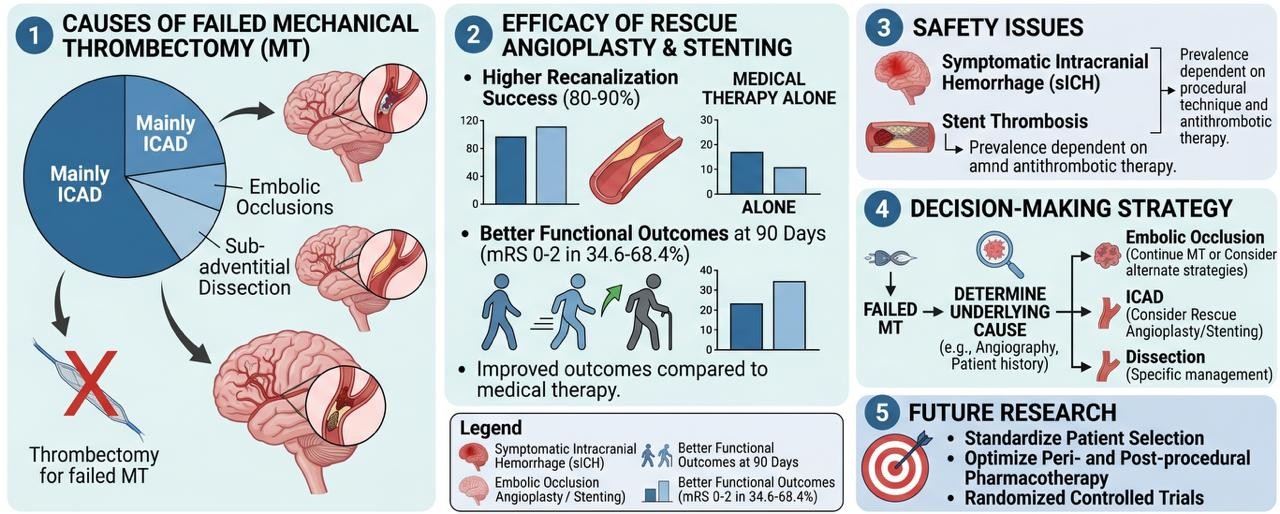
Acute ischemic stroke (AIS) due to large vessel occlusion (LVO) has continued to be a significant cause of mortality and disability worldwide. The standard treatment is mechanical thrombectomy (MT); still, the failure of recanalization can take place in 25-30 percent of the cases, frequently because of intracranial atherosclerotic disease (ICAD) underlying the thrombectomy. Possible interventions such as rescue angioplasty and stenting have appeared to be potential interventions on refractory LVO after unsuccessful MT. A qualitative synthesis was performed on 25 studies that have been published since January 2018 and up to May 2025 to evaluate their efficacy and safety. ICAD was mainly associated with failed MT, and secondary causes were embolic occlusions and sub adventitial dissection. Rescue angioplasty and stenting had a higher recanalization success (80-90) and had better functional outcomes at 90days (modified Rankin Scale 0-2 in 34.6-68.4% of patients) than medical therapy alone did. Symptomatic intracranial hemorrhage and stent thrombosis were the main safety issues, and their prevalence was dependent on the method of the procedure and antithrombotic treatment. The strategies of decision making were based on the consideration of the cause of failed MT and subsequent intervention based on it. Future research to determine the role of rescue angioplasty and stenting in the management of refractory LVO stroke should focus on standardizing patient selection, optimizing peri and post procedural pharmacotherapy, and randomized controlled trials.
Keywords: Acute ischemic stroke, Intravenous thrombolysis, Mechanical thrombectomy, large vessel occlusion, Intracranial hemorrhage
Graphical Abstract:
Reseach Highlights:
- Make it clear that intracranial atherosclerotic disease is the main reason of mechanical thrombectomy failure.
- Show that rescue angioplasty and stenting is highly effective in recanalizing refractory large vessel occlusion.
- Explain better functional outcomes at 90 days after rescue endovascular intervention for failed thrombectomy.
- Recognize that the primary safety risk of "rescue therapies" is ICP.
- Emphasize the need for uniform criteria for patient selection and peri-procedural treatment.
Type of Study: Review Article |
Subject:
Neurodegenerative Disease
Received: 2025/06/18 | Accepted: 2025/08/5 | Published: 2025/08/10
Received: 2025/06/18 | Accepted: 2025/08/5 | Published: 2025/08/10
References
1. Feigin VL, Brainin M, Norrving B, Martins SO, Pandian J, Lindsay P, et al. World Stroke Organization: global stroke fact sheet 2025. Int J Stroke. 2025;20(2):132-44. doi:10.1177/17474930241308142. [DOI:10.1177/17474930241308142] [PMID] [PMCID]
2. National Institute of Neurological Disorders and Stroke rt-PA Stroke Study Group. Tissue plasminogen activator for acute ischemic stroke. N Engl J Med. 1995;333(24):1581-7. doi:10.1056/NEJM199512143332401. [DOI:10.1056/NEJM199512143332401] [PMID] [PMCID]
3. Jovin TG, Chamorro A, Cobo E, de Miquel MA, Molina CA, Rovira A, et al. Thrombectomy within 8 hours after symptom onset in ischemic stroke. N Engl J Med. 2015;372(24):2296-306. doi:10.1056/NEJMoa1503780. [DOI:10.1056/NEJMoa1503780] [PMID] [PMCID]
4. Saver JL, Goyal M, Bonafé A, Diener HC, Levy EI, Pereira VM, et al. Stent-retriever thrombectomy after intravenous t-PA vs t-PA alone in stroke. N Engl J Med. 2015;372(24):2285-95. doi:10.1056/NEJMoa1415061. [DOI:10.1056/NEJMoa1415061] [PMID] [PMCID]
5. Yoshimura S, Sakai N, Yamagami H, Uchida K, Beppu M, Toyoda K, et al. Endovascular therapy for acute stroke with a large ischemic region. N Engl J Med. 2022;386(14):1303-13. doi:10.1056/NEJMoa2118191. [DOI:10.1056/NEJMoa2118191] [PMID]
6. Nogueira RG, Jadhav AP, Haussen DC, Bonafé A, Budzik RF, Bhuva P, et al. Thrombectomy 6 to 24 hours after stroke with a mismatch between deficit and infarct. N Engl J Med. 2018;378(1):11-21. doi:10.1056/NEJMoa1706442. [DOI:10.1056/NEJMoa1706442] [PMID] [PMCID]
7. Fugate JE, Klunder AM, Kallmes DF. What is meant by "TICI"? AJNR Am J Neuroradiol. 2013;34(9):1792-7. doi:10.3174/ajnr.A3496. [DOI:10.3174/ajnr.A3496] [PMID] [PMCID]
8. Mahmoud NA, Abdalkader M, Al Kasab S, de Havenon A, Tong X, Jia B, et al. Rescue stenting in refractory mechanical thrombectomy: a review. Ann Neurosci. 2024. doi:10.36922/an.3950. [DOI:10.36922/an.3950]
9. Sweid A, Sajja KC, Mouchtouris N, Weinberg JH, Shivashankar K, Saad H, et al. Rescue stenting for acute ischemic stroke with refractory emergent large vessel occlusion in the modern thrombectomy era. Clin Neurol Neurosurg. 2022;215:107183. doi:10.1016/j.clineuro.2022.107183. [DOI:10.1016/j.clineuro.2022.107183] [PMID]
10. Marnat G, Gory B, Sibon I, Kyheng M, Labreuche J, Boulouis G, et al. Mechanical thrombectomy failure in anterior circulation strokes: outcomes and predictors of favorable outcomes. Eur J Neurol. 2022;29(9):2701-7. doi:10.1111/ene.15429. [DOI:10.1111/ene.15429] [PMID] [PMCID]
11. Neumann A, Schildhauer P, Weiler SM, Schramm P, Schacht H, Royl G, et al. Mechanical thrombectomy failure in anterior and posterior circulation stroke: current results from a high-volume comprehensive center. Neurol Sci. 2025;46(2):807-17. doi:10.1007/s10072-024-07881-2. [DOI:10.1007/s10072-024-07881-2] [PMID] [PMCID]
12. Stracke CP, Fiehler J, Meyer L, Thomalla G, Krause LU, Lowens S, et al. Emergency intracranial stenting in acute stroke: predictors for poor outcome and for complications. J Am Heart Assoc. 2020;9(5):e012795. doi:10.1161/JAHA.119.012795. [DOI:10.1161/JAHA.119.012795] [PMID] [PMCID]
13. Li W, Sui X, Li C, Zhao W, Yuan S, Dou S, et al. Emergency angioplasty or stenting for stroke patients with intracranial atherosclerotic large vessel occlusion. J Atheroscler Thromb. 2023;30(2):160-9. doi:10.5551/jat.63381. [DOI:10.5551/jat.63381] [PMID] [PMCID]
14. Mohammaden MH, Haussen DC, Al-Bayati AR, Hassan A, Tekle W, Fifi J, et al. Stenting and angioplasty in neurothrombectomy: matched analysis of rescue intracranial stenting versus failed thrombectomy. Stroke. 2022;53(9):2779-88. doi:10.1161/STROKEAHA.121.038248. [DOI:10.1161/STROKEAHA.121.038248] [PMID]
15. Maingard J, Phan K, Lamanna A, Kok HK, Barras CD, Russell J, et al. Rescue intracranial stenting after failed mechanical thrombectomy for acute ischemic stroke: a systematic review and meta-analysis. World Neurosurg. 2019;132:e235-45. doi:10.1016/j.wneu.2019.08.192. [DOI:10.1016/j.wneu.2019.08.192] [PMID]
16. Yang D, Lin M, Wang S, Wang H, Hao Y, Zi W, et al. Primary angioplasty and stenting may be superior to thrombectomy for acute atherosclerotic large-artery occlusion. Interv Neuroradiol. 2018;24(4):412-20. doi:10.1177/1591019918763380. [DOI:10.1177/1591019918763380] [PMID] [PMCID]
17. Jiang Y, Li C, Shi M, Song K, Cong M, Zhang W, et al. Comparing the effectiveness and safety of rescue balloon angioplasty versus stenting in acute large vessel occlusion after thrombectomy. Stroke Vasc Neurol. 2025. doi:10.1136/svn-2024-003851. [DOI:10.1136/svn-2024-003851] [PMID] [PMCID]
18. MA, Bendszus M, Bösel J, et al. Rescue stenting in endovascular treatment of acute ischemic stroke: a retrospective multicenter analysis. J Neurointerv Surg. 2024;16(2):115-22. doi:10.1136/jnis-2023-020346.
19. Zhang L, Huang Q, Zhang Y, et al. Rescue treatment with glycoprotein IIb/IIIa inhibitors for acute ischemic stroke after failed mechanical thrombectomy: a systematic review and meta-analysis. Front Neurol. 2023;14:1181295. doi:10.3389/fneur.2023.1181295. [DOI:10.3389/fneur.2023.1181295] [PMID] [PMCID]
20. Nguyen TN, Nguyen HT, Le VT, et al. Rescue therapy with balloon angioplasty and stenting after failed mechanical thrombectomy in intracranial atherosclerotic stenosis-related large vessel occlusion. Clin Ter. 2022;173(5):413-20. doi:10.7417/CT.2022.2453.
21. Lee JS, Lee SJ, Yoo JS, et al. Direct stenting versus stent retriever thrombectomy in acute ischemic stroke due to large vessel occlusion. J Neurointerv Surg. 2020;12(8):749-53. doi:10.1136/neurintsurg-2019-015513.
22. Lee JS, Kim YJ, Lee SJ, et al. Rescue stenting after failed mechanical thrombectomy for acute ischemic stroke due to underlying intracranial atherosclerosis. J Cerebrovasc Endovasc Neurosurg. 2022;24(3):120-8. doi:10.7461/jcen.2022.E2022.08.002. [DOI:10.7461/jcen.2022.E2022.08.002] [PMID] [PMCID]
23. Mohammaden MH, Haussen DC, Perry da Camara C, et al. Rescue stenting versus medical management in patients with acute ischemic stroke due to large vessel occlusion and underlying intracranial atherosclerosis: a systematic review and meta-analysis. Eur Stroke J. 2024. doi:10.1177/23969873241308680. [DOI:10.1177/23969873241308680] [PMID] [PMCID]
24. Chang Y, Kim BM, Baek JH, et al. Rescue stenting after failure of endovascular thrombectomy: a multicenter study. Front Neurol. 2020;11:556. doi:10.3389/fneur.2020.00556. [DOI:10.3389/fneur.2020.00556] [PMID] [PMCID]
25. Chimowitz MI, Lynn MJ, Derdeyn CP, et al. Stenting versus aggressive medical therapy for intracranial arterial stenosis. N Engl J Med. 2011;365(11):993-1003. doi:10.1056/NEJMoa1105335. [DOI:10.1056/NEJMoa1105335] [PMID] [PMCID]
26. Gao P, Wang T, Wang D, et al. Effect of stenting plus medical therapy vs medical therapy alone on risk of stroke and death in patients with symptomatic intracranial stenosis: the CASSISS randomized clinical trial. JAMA. 2022;328(6):534-42. doi:10.1001/jama.2022.11669. [DOI:10.1001/jama.2022.18921] [PMID]
27. Yi T, Gan S, Chen Z, Wu YM, Lin DL, Lin XH, et al. Application of balloon-expandable stent angioplasty with distal support of the stent-retriever (BASIS-Stent) technique for acute intracranial artery atherosclerosis-related occlusion. J Neurointerv Surg. 2025. doi:10.1136/jnis-2024-022862. [DOI:10.1136/jnis-2024-022862] [PMID] [PMCID]
Send email to the article author
| Rights and permissions | |
 |
This work is licensed under a Creative Commons Attribution-NonCommercial 4.0 International License. |


.png)
