
Life Neuroscience
NeuroLife
Sun, Oct 25, 2026
[Archive]
Volume 3, Issue 1 (1-2025)
Neuroscience Updates 2025, 3(1): 101-115 |
Back to browse issues page




Download citation:
BibTeX | RIS | EndNote | Medlars | ProCite | Reference Manager | RefWorks
Send citation to:


BibTeX | RIS | EndNote | Medlars | ProCite | Reference Manager | RefWorks
Send citation to:
Abbasi A A, Fereidouni A, Moradikor N. LRP1 and Microglial Dysfunction in Alzheimer’s Disease: Mechanistic Crosstalk, Dual-Target Therapeutic Strategies, and Sleep-Oriented Adjunctive Approaches. Neuroscience Updates 2025; 3 (1) :101-115
URL: http://neuroupdates.de/article-1-129-en.html
URL: http://neuroupdates.de/article-1-129-en.html


1- International Center for Neuroscience Research, Institute for Intelligent Research, Tbilisi, Georgia
Abstract: (2670 Views)
A progressive decline in cognitive ability characterizes Alzheimer’s Disease (AD) as a result of the deposition of amyloid-β (Aβ) and persistent neuroinflammatory response. A significant contributor involved in these changes is the low-density lipoprotein receptor-related protein 1 (LRP1). It is a key mediator of Aβ clearance, and its downregulation with age and disease hastens amyloid accumulation. In chronic exposure to Aβ, in the end, leads to the formation of a microglial senescence-associated secretory phenotype SASP associated with inflammation, a loss of phagocytosis, and lysosomal dysfunction. Enhanced intracellular protein accumulation caused by dysfunctional microglia worsens neurodegenerative progression by impairing chaperone-mediated autophagy (CMA). This research examines the neurodegenerative crosstalk of the LRP1–Aβ–Microglia axis. This approach presents an innovative solution to dual-target therapy by combining CAR-transcriptionally modified microglia to boost extracellular Aβ clearance and enhance intracellular proteolytic pathways, specifically LRP1 and CMA. This strategy aims to relieve the burden of amyloid burden, restore homeostasis, and reduce pathogenic inflammation by combining receptor-mediated clearance with engineered phagocytic activity. Moreover, available literature is discussed about glymphatic dysfunctions and microglial dysregulation, their relation to sleep disturbances, and the potential of sleep-supportive therapies such as sake yeast sleep-supporting supplements as adjunct therapies to enhance cognitive resilience in Alzheimer’s Disease (AD). Integrating these mechanistic insights with progress in therapeutics emphasizes the multifaceted approaches to mitigating the impacts of Alzheimer's disease pathology.
Keywords: Alzheimer’s disease, LRP1, Microglial dysfunction, Amyloid‐β clearance, CAR-microglia, Neuroinflammation
Graphical Abstract:
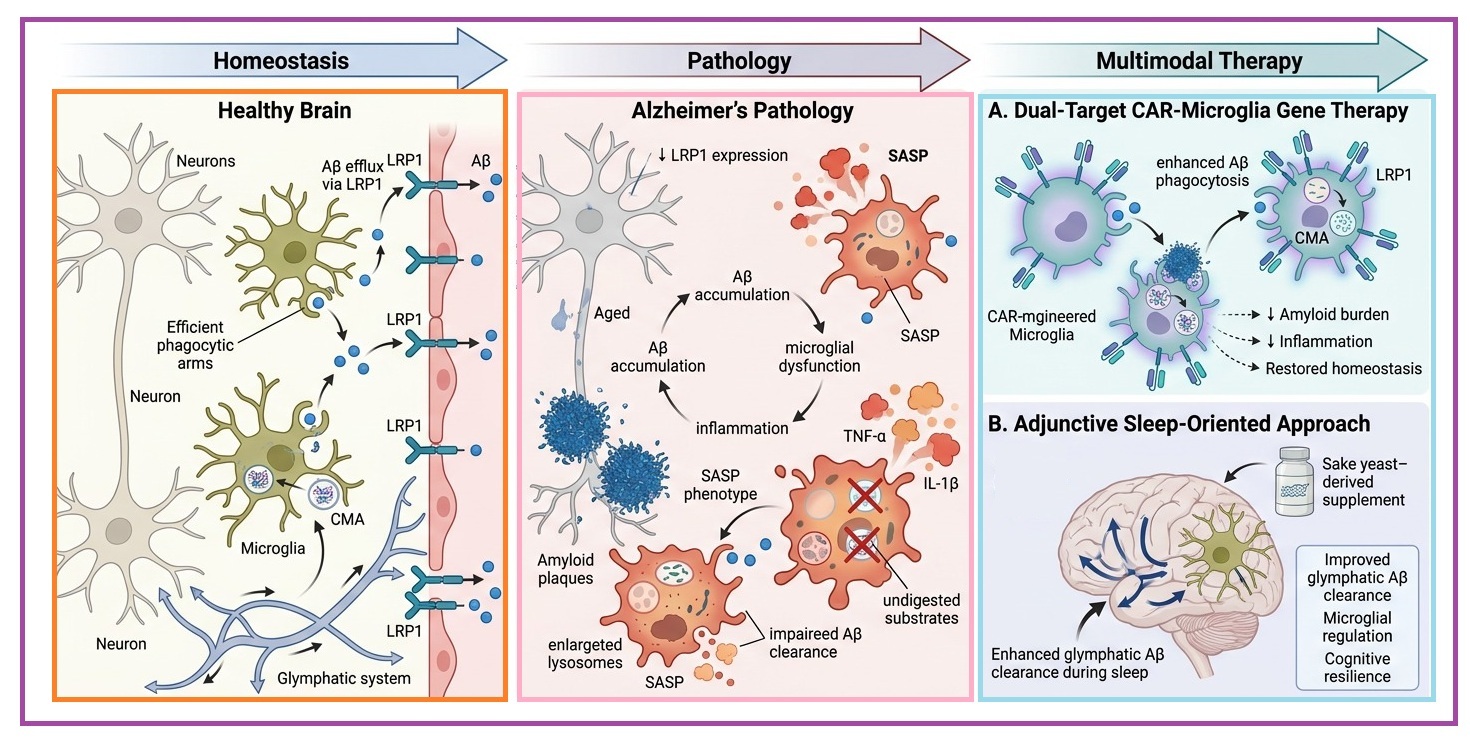
Reseach Highlights:
- LRP1 downregulation impairs amyloid-beta clearance, accelerating Alzheimer's disease progression.
- Microglial senescence drives inflammation, phagocytic loss, and lysosomal dysfunction.
- Dual-target therapy combines engineered microglia with LRP1 and CMA enhancement.
- Glymphatic dysfunction and sleep disturbances worsen microglial dysregulation in Alzheimer's.
- Sleep-supportive supplements offer adjunct therapy to boost cognitive resilience.
Type of Study: Review Article |
Subject:
Neurodegenerative Disease
Received: 2025/08/25 | Accepted: 2025/10/15 | Published: 2025/10/25
Received: 2025/08/25 | Accepted: 2025/10/15 | Published: 2025/10/25
References
1. Monteiro, A.R., et al., Alzheimer's disease: Insights and new prospects in disease pathophysiology, biomarkers and disease-modifying drugs. Biochemical Pharmacology, 2023. 211: p. 115522. [DOI:10.1016/j.bcp.2023.115522] [PMID]
2. Zhang, J., et al., Pathological mechanisms and treatment progression of Alzheimer's disease. Eur J Med Res, 2025. 30(1): p. 625. [DOI:10.1186/s40001-025-02886-9] [PMID] [PMCID]
3. Kuhn, M.K. and E.A. Proctor, Microglial Drivers of Alzheimer's Disease Pathology: An Evolution of Diverse Participating States. Proteins, 2025. 93(8): p. 1330-1348. [DOI:10.1002/prot.26723] [PMID] [PMCID]
4. Faissner, A., Low-density lipoprotein receptor-related protein-1 (LRP1) in the glial lineage modulates neuronal excitability. Frontiers in Network Physiology, 2023. Volume 3 - 2023. [DOI:10.3389/fnetp.2023.1190240] [PMID] [PMCID]
5. Gao, C., et al., Microglia in neurodegenerative diseases: mechanism and potential therapeutic targets. Signal transduction and targeted therapy, 2023. 8(1): p. 359. [DOI:10.1038/s41392-023-01588-0] [PMID] [PMCID]
6. Costa, J., et al., The old guard: Age-related changes in microglia and their consequences. Mechanisms of Ageing and Development, 2021. 197: p. 111512. [DOI:10.1016/j.mad.2021.111512] [PMID]
7. Zhang, W., et al., Role of neuroinflammation in neurodegeneration development. Signal transduction and targeted therapy, 2023. 8(1): p. 267. [DOI:10.1038/s41392-023-01486-5] [PMID] []
8. Miao, J., et al., Microglia in Alzheimer's disease: pathogenesis, mechanisms, and therapeutic potentials. Front Aging Neurosci, 2023. 15: p. 1201982. [DOI:10.3389/fnagi.2023.1201982] [PMID] [PMCID]
9. Parhizkar, S., et al., Sleep deprivation exacerbates microglial reactivity and Aβ deposition in a TREM2-dependent manner in mice. Sci Transl Med, 2023. 15(693): p. eade6285. [DOI:10.1126/scitranslmed.ade6285] [PMID] [PMCID]
10. Auderset, L., et al., Low-Density Lipoprotein Receptor-Related Protein 1 (LRP1) Is a Negative Regulator of Oligodendrocyte Progenitor Cell Differentiation in the Adult Mouse Brain. Frontiers in Cell and Developmental Biology, 2020. Volume 8 - 2020. [DOI:10.3389/fcell.2020.564351] [PMID] [PMCID]
11. Storck, S.E., et al., Endothelial LRP1 transports amyloid-β 1-42 across the blood-brain barrier. The Journal of clinical investigation, 2016. 126(1): p. 123-136. [DOI:10.1172/JCI81108] [PMID] [PMCID]
12. Alshahrani, S.M., et al., LRP1 at the crossroads of Parkinson's and Alzheimer's: Divergent roles in α-synuclein and amyloid pathology. European Journal of Pharmacology, 2025. 1002: p. 177830. [DOI:10.1016/j.ejphar.2025.177830] [PMID]
13. Campos-Peña, V., et al., Amyloid β, Lipid Metabolism, Basal Cholinergic System, and Therapeutics in Alzheimer's Disease. Int J Mol Sci, 2022. 23(20). [DOI:10.3390/ijms232012092] [PMID] []
14. Long, H.-Z., et al., PI3K/AKT Signal Pathway: A Target of Natural Products in the Prevention and Treatment of Alzheimer's Disease and Parkinson's Disease. Frontiers in Pharmacology, 2021. Volume 12 - 2021. [DOI:10.3389/fphar.2021.648636] [PMID] [PMCID]
15. Dutta, H. and N. Jain, Post-translational modifications and their implications in cancer. Front Oncol, 2023. 13: p. 1240115. [DOI:10.3389/fonc.2023.1240115] [PMID] [PMCID]
16. Auderset, L., C.L. Cullen, and K.M. Young, Low Density Lipoprotein-Receptor Related Protein 1 Is Differentially Expressed by Neuronal and Glial Populations in the Developing and Mature Mouse Central Nervous System. PLoS One, 2016. 11(6): p. e0155878. [DOI:10.1371/journal.pone.0155878] [PMID] [PMCID]
17. Darabi, S., et al., Lipidopathy disrupts peripheral and central amyloid clearance in Alzheimer's disease: Where are our knowledge. IBRO Neurosci Rep, 2025. 18: p. 191-199. [DOI:10.1016/j.ibneur.2025.01.004] [PMID] [PMCID]
18. Raulin, A.C., et al., ApoE in Alzheimer's disease: pathophysiology and therapeutic strategies. Mol Neurodegener, 2022. 17(1): p. 72. [DOI:10.1186/s13024-022-00574-4] [PMID] [PMCID]
19. Chen, Y., et al., The multifaceted roles of apolipoprotein E4 in Alzheimer's disease pathology and potential therapeutic strategies. Cell Death Discov, 2025. 11(1): p. 312. [DOI:10.1038/s41420-025-02600-y] [PMID] [PMCID]
20. Adamu, A., et al., The role of neuroinflammation in neurodegenerative diseases: current understanding and future therapeutic targets. Front Aging Neurosci, 2024. 16: p. 1347987. [DOI:10.3389/fnagi.2024.1347987] [PMID] [PMCID]
21. Liu, C.-C., et al., Astrocytic LRP1 mediates brain Aβ clearance and impacts amyloid deposition. Journal of Neuroscience, 2017. 37(15): p. 4023-4031. [DOI:10.1523/JNEUROSCI.3442-16.2017] [PMID] [PMCID]
22. Colonna, M. and O. Butovsky, Microglia Function in the Central Nervous System During Health and Neurodegeneration. Annu Rev Immunol, 2017. 35: p. 441-468. [DOI:10.1146/annurev-immunol-051116-052358] [PMID] [PMCID]
23. Guo, S., H. Wang, and Y. Yin, Microglia Polarization From M1 to M2 in Neurodegenerative Diseases. Front Aging Neurosci, 2022. 14: p. 815347. [DOI:10.3389/fnagi.2022.815347] [PMID] [PMCID]
24. Hudson, H.R., X. Sun, and M.E. Orr, Senescent brain cell types in Alzheimer's disease: Pathological mechanisms and therapeutic opportunities. Neurotherapeutics, 2025. 22(3): p. e00519. [DOI:10.1016/j.neurot.2024.e00519] [PMID] [PMCID]
25. Miao, J., et al., Microglial Metabolic Reprogramming: Emerging Insights and Therapeutic Strategies in Neurodegenerative Diseases. Cell Mol Neurobiol, 2023. 43(7): p. 3191-3210. [DOI:10.1007/s10571-023-01376-y] [PMID] [PMCID]
26. Lepiarz-Raba, I., et al., Metabolic regulation of microglial phagocytosis: Implications for Alzheimer's disease therapeutics. Transl Neurodegener, 2023. 12(1): p. 48. [DOI:10.1186/s40035-023-00382-w] [PMID] [PMCID]
27. Qiu, Z., et al., Programmed Death of Microglia in Alzheimer's Disease: Autophagy, Ferroptosis, and Pyroptosis. The Journal of Prevention of Alzheimer's Disease, 2023. 10(1): p. 95-103. [DOI:10.14283/jpad.2023.3] [PMID]
28. Yao, R. and J. Shen, Chaperone-mediated autophagy: Molecular mechanisms, biological functions, and diseases. MedComm (2020), 2023. 4(5): p. e347. [DOI:10.1002/mco2.347] [PMID] [PMCID]
29. Liu, C.C., et al., Astrocytic LRP1 Mediates Brain Aβ Clearance and Impacts Amyloid Deposition. J Neurosci, 2017. 37(15): p. 4023-4031. [DOI:10.1523/JNEUROSCI.3442-16.2017] [PMID] [PMCID]
30. Cordos, B., et al., Synergistic Autophagy-Related Mechanisms of Protection Against Brain Aging and AD: Cellular Pathways and Therapeutic Strategies. Pharmaceuticals (Basel), 2025. 18(6). [DOI:10.3390/ph18060829] [PMID] [PMCID]
31. Cai, Y., et al., Microglia in the Neuroinflammatory Pathogenesis of Alzheimer's Disease and Related Therapeutic Targets. Front Immunol, 2022. 13: p. 856376. [DOI:10.3389/fimmu.2022.856376] [PMID] []
32. Shinohara, M., et al., Role of LRP1 in the pathogenesis of Alzheimer's disease: evidence from clinical and preclinical studies. J Lipid Res, 2017. 58(7): p. 1267-1281. [DOI:10.1194/jlr.R075796] [PMID] [PMCID]
33. Shinohara, M., et al., Role of LRP1 in the pathogenesis of Alzheimer's disease: evidence from clinical and preclinical studies: Thematic Review Series: ApoE and Lipid Homeostasis in Alzheimer's Disease. Journal of Lipid Research, 2017. 58(7): p. 1267-1281. [DOI:10.1194/jlr.R075796] [PMID] [PMCID]
34. Rim, C., et al., Emerging role of senescent microglia in brain aging-related neurodegenerative diseases. Transl Neurodegener, 2024. 13(1): p. 10. [DOI:10.1186/s40035-024-00402-3] [PMID] [PMCID]
35. He, Y., et al., LRP1 knockdown aggravates Aβ(1-42)-stimulated microglial and astrocytic neuroinflammatory responses by modulating TLR4/NF-κB/MAPKs signaling pathways. Exp Cell Res, 2020. 394(2): p. 112166. [DOI:10.1016/j.yexcr.2020.112166] [PMID]
36. Yang, L., et al., LRP1 modulates the microglial immune response via regulation of JNK and NF-κB signaling pathways. J Neuroinflammation, 2016. 13(1): p. 304. [DOI:10.1186/s12974-016-0772-7] [PMID] [PMCID]
37. He, Y., et al., Silencing of LRP1 Exacerbates Inflammatory Response Via TLR4/NF-κB/MAPKs Signaling Pathways in APP/PS1 Transgenic Mice. Mol Neurobiol, 2020. 57(9): p. 3727-3743. [DOI:10.1007/s12035-020-01982-7] [PMID]
38. Xie, C. and Y. Liu, LRP1 as a potential diagnostic and immunomodulatory target in endometriosis: evidence from multi-omics and single-cell analyses. Frontiers in Immunology, 2026. Volume 17 - 2026. [DOI:10.3389/fimmu.2026.1735221] [PMID] [PMCID]
39. Zhang, G., et al., Microglia in Alzheimer's Disease: A Target for Therapeutic Intervention. Frontiers in Cellular Neuroscience, 2021. Volume 15 - 2021. [DOI:10.3389/fncel.2021.749587] [PMID] [PMCID]
40. Heiss, C.N., et al., Expression of anti-amyloid CARs in microglia promotes efficient and selective phagocytosis of Aβ1-42. Gene Ther, 2025. 32(4): p. 333-338. [DOI:10.1038/s41434-025-00534-9] [PMID] [PMCID]
41. Baik, S.H., et al., A Breakdown in Metabolic Reprogramming Causes Microglia Dysfunction in Alzheimer's Disease. Cell Metabolism, 2019. 30(3): p. 493-507.e6. [DOI:10.1016/j.cmet.2019.06.005] [PMID]
42. Yoo, J., et al., Multi-target-directed therapeutic strategies for Alzheimer's disease: controlling amyloid-β aggregation, metal ion homeostasis, and enzyme inhibition. Chem Sci, 2025. 16(5): p. 2105-2135. [DOI:10.1039/D4SC06762B] [PMID] [PMCID]
43. Moreno-Blas, D., E. Gorostieta-Salas, and S. Castro-Obregón, Connecting chaperone-mediated autophagy dysfunction to cellular senescence. Ageing Research Reviews, 2018. 41: p. 34-41. [DOI:10.1016/j.arr.2017.11.001] [PMID]
44. Han, Z., X. Yang, and S. Huang, Sleep deprivation: A risk factor for the pathogenesis and progression of Alzheimer's disease. Heliyon, 2024. 10(7): p. e28819. [DOI:10.1016/j.heliyon.2024.e28819] [PMID] [PMCID]
45. Rossman, J., Cognitive-Behavioral Therapy for Insomnia: An Effective and Underutilized Treatment for Insomnia. Am J Lifestyle Med, 2019. 13(6): p. 544-547. [DOI:10.1177/1559827619867677] [PMID] [PMCID]
46. Abou-Khalil, R., Nutritional Interventions for Enhancing Sleep Quality: The Role of Diet and Key Nutrients in Regulating Sleep Patterns and Disorders. Food Sci Nutr, 2025. 13(12): p. e71309. [DOI:10.1002/fsn3.71309] [PMID] [PMCID]
47. Zang, L., et al., The effect of light therapy on sleep disorders and psychobehavioral symptoms in patients with Alzheimer's disease: A meta-analysis. PLoS One, 2023. 18(12): p. e0293977. [DOI:10.1371/journal.pone.0293977] [PMID] [PMCID]
48. Maksour, S. and L. Ooi, Innovations advancing our understanding of microglia in Alzheimer's disease: From in vitro to in vivo models. J Neurochem, 2023. 166(3): p. 497-516. [DOI:10.1111/jnc.15885] [PMID]
49. Cakir, B., F.R. Kiral, and I.-H. Park, Advanced in vitro models: Microglia in action. Neuron, 2022. 110(21): p. 3444-3457. [DOI:10.1016/j.neuron.2022.10.004] [PMID]
50. Hartung, T., AI, agentic models and lab automation for scientific discovery - the beginning of scAInce. Front Artif Intell, 2025. 8: p. 1649155. [DOI:10.3389/frai.2025.1649155] [PMID] [PMCID]
51. Mrza, M.A., J. He, and Y. Wang, Integration of iPSC-Derived Microglia into Brain Organoids for Neurological Research. Int J Mol Sci, 2024. 25(6). [DOI:10.3390/ijms25063148] [PMID] [PMCID]
52. Zhang, W., et al., Microglia-containing human brain organoids for the study of brain development and pathology. Mol Psychiatry, 2023. 28(1): p. 96-107. [DOI:10.1038/s41380-022-01892-1] [PMID] [PMCID]
53. Hierro-Bujalance, C., B.J. Bacskai, and M. Garcia-Alloza, In Vivo Imaging of Microglia With Multiphoton Microscopy. Frontiers in Aging Neuroscience, 2018. Volume 10 - 2018. [DOI:10.3389/fnagi.2018.00218] [PMID] [PMCID]
54. Ren, F., et al., Artificial intelligence-driven multi-omics approaches in Alzheimer's disease: Progress, challenges, and future directions. Acta Pharm Sin B, 2025. 15(9): p. 4327-4385. [DOI:10.1016/j.apsb.2025.07.030] [PMID] [PMCID]
55. Sun, N., et al., Human microglial state dynamics in Alzheimer’s disease progression. Cell, 2023. 186(20): p. 4386-4403.e29. [DOI:10.1016/j.cell.2023.08.037] [PMID] [PMCID]
56. Reid, K.M. and G.C. Brown, LRPAP1 is released from activated microglia and inhibits microglial phagocytosis and amyloid beta aggregation. Frontiers in Immunology, 2023. Volume 14 - 2023. [DOI:10.3389/fimmu.2023.1286474] [PMID] [PMCID]
57. Sabogal-Guáqueta, A.M., et al., Species-specific metabolic reprogramming in human and mouse microglia during inflammatory pathway induction. Nat Commun, 2023. 14(1): p. 6454. [DOI:10.1038/s41467-023-42096-7] [PMID] [PMCID]
58. Paul, J.K., et al., Advancing Alzheimer's Therapy: Computational strategies and treatment innovations. IBRO Neurosci Rep, 2025. 18: p. 270-282. [DOI:10.1016/j.ibneur.2025.02.002] [PMID] [PMCID]
59. Dong, Y., et al., Drug Development for Alzheimer's Disease: Microglia Induced Neuroinflammation as a Target? Int J Mol Sci, 2019. 20(3). [DOI:10.3390/ijms20030558] [PMID] [PMCID]
60. Roveta, F., et al., Neuroinflammatory Biomarkers in Alzheimer's Disease: From Pathophysiology to Clinical Implications. Int J Mol Sci, 2024. 25(22). [DOI:10.3390/ijms252211941] [PMID] [PMCID]
61. Garbarino, V.R., et al., Evaluation of exploratory fluid biomarkers from a phase 1 senolytic trial in mild Alzheimer's disease. Neurotherapeutics, 2025. 22(4): p. e00591. [DOI:10.1016/j.neurot.2025.e00591] [PMID] [PMCID]
62. Rossano, S.M., et al., Microglia measured by TSPO PET are associated with Alzheimer's disease pathology and mediate key steps in a disease progression model. Alzheimers Dement, 2024. 20(4): p. 2397-2407. [DOI:10.1002/alz.13699] [PMID] [PMCID]
63. Hao, Y., et al., Bioengineered microglia-targeted exosomes facilitate Aβ clearance via enhancing activity of microglial lysosome for promoting cognitive recovery in Alzheimer's disease. Biomater Adv, 2022. 136: p. 212770. [DOI:10.1016/j.bioadv.2022.212770] [PMID]
64. Rani, S., et al., Advanced Overview of Biomarkers and Techniques for Early Diagnosis of Alzheimer's Disease. Cell Mol Neurobiol, 2023. 43(6): p. 2491-2523. [DOI:10.1007/s10571-023-01330-y] [PMID] [PMCID]
65. Ghosh, S., et al., Neuroimmune Dysregulation and AI-Driven Therapeutic Strategies in Alzheimer's Disease. Cell Mol Neurobiol, 2025. 46(1): p. 17. [DOI:10.1007/s10571-025-01651-0] [PMID] [PMCID]
Send email to the article author
| Rights and permissions | |
 |
This work is licensed under a Creative Commons Attribution-NonCommercial 4.0 International License. |


.png)
