
Life Neuroscience
NeuroLife
Thu, Oct 22, 2026
[Archive]
Volume 3, Issue 1 (1-2025)
Neuroscience Updates 2025, 3(1): 51-61 |
Back to browse issues page




Download citation:
BibTeX | RIS | EndNote | Medlars | ProCite | Reference Manager | RefWorks
Send citation to:


BibTeX | RIS | EndNote | Medlars | ProCite | Reference Manager | RefWorks
Send citation to:
Prakash A J, Kukchishvili M, Alavidze K, Mohamed Khider M A, Afanwi Q C, Yousuf Elnour M M. Regenerative Peripheral Nerve Interfaces for management of Phantom limb pain in amputees. Neuroscience Updates 2025; 3 (1) :51-61
URL: http://neuroupdates.de/article-1-126-en.html
URL: http://neuroupdates.de/article-1-126-en.html
Arjun Jay Prakash *1 

 , Mariam Kukchishvili1 , Ketevani Alavidze2 , Moustapha Abdelgadir Mohamed Khider3 , Quirina Cho Afanwi4 , Mohammed Muneer Yousuf Elnour5
, Mariam Kukchishvili1 , Ketevani Alavidze2 , Moustapha Abdelgadir Mohamed Khider3 , Quirina Cho Afanwi4 , Mohammed Muneer Yousuf Elnour5
1- Ivane Javakhishvili Tbilisi State University, Tbilisi, Georgia
2- David Tvildiani Medical University, Tbilisi, Georgia
3- Tbilisi State Medical University, Tbilisi, Georgia
4- New Vision University, Tbilisi, Georgia
5- Hamad General Hospital, Doha, Qatar
2- David Tvildiani Medical University, Tbilisi, Georgia
3- Tbilisi State Medical University, Tbilisi, Georgia
4- New Vision University, Tbilisi, Georgia
5- Hamad General Hospital, Doha, Qatar
Abstract: (2353 Views)
Phantom limb pain (PLP) and symptomatic neuromas remain major barriers to recovery after limb amputation, often limiting prosthetic use, mobility, and quality of life. Regenerative Peripheral Nerve Interfaces (RPNIs) have emerged as a promising biologically grounded technique for both neuroma prevention and targeted treatment of neuropathic post-amputation pain. This review synthesizes current evidence on RPNIs with specific attention to their surgical design, neurophysiological basis, and clinical effectiveness in reducing PLP and residual limb pain. In addition, the review examines mechanisms of axonal regeneration, the role of denervated muscle grafts in providing physiologic end-targets, and the potential of RPNIs to restore stable, high-fidelity motor signals for myoelectric prosthetic control. Comparative insights with Targeted Muscle Reinnervation (TMR) are included where appropriate. The aim is to provide a consolidated understanding of how RPNIs function at biological, electrophysiological, and clinical levels, and to identify current limitations and future directions in post-amputation nerve reconstruction.
Keywords: Regenerative Peripheral Nerve Interface, Phantom Limb Pain, Phantom Limb Syndrome, Neuropathic Pain, Bionic Prosthesis, Myoelectric Control
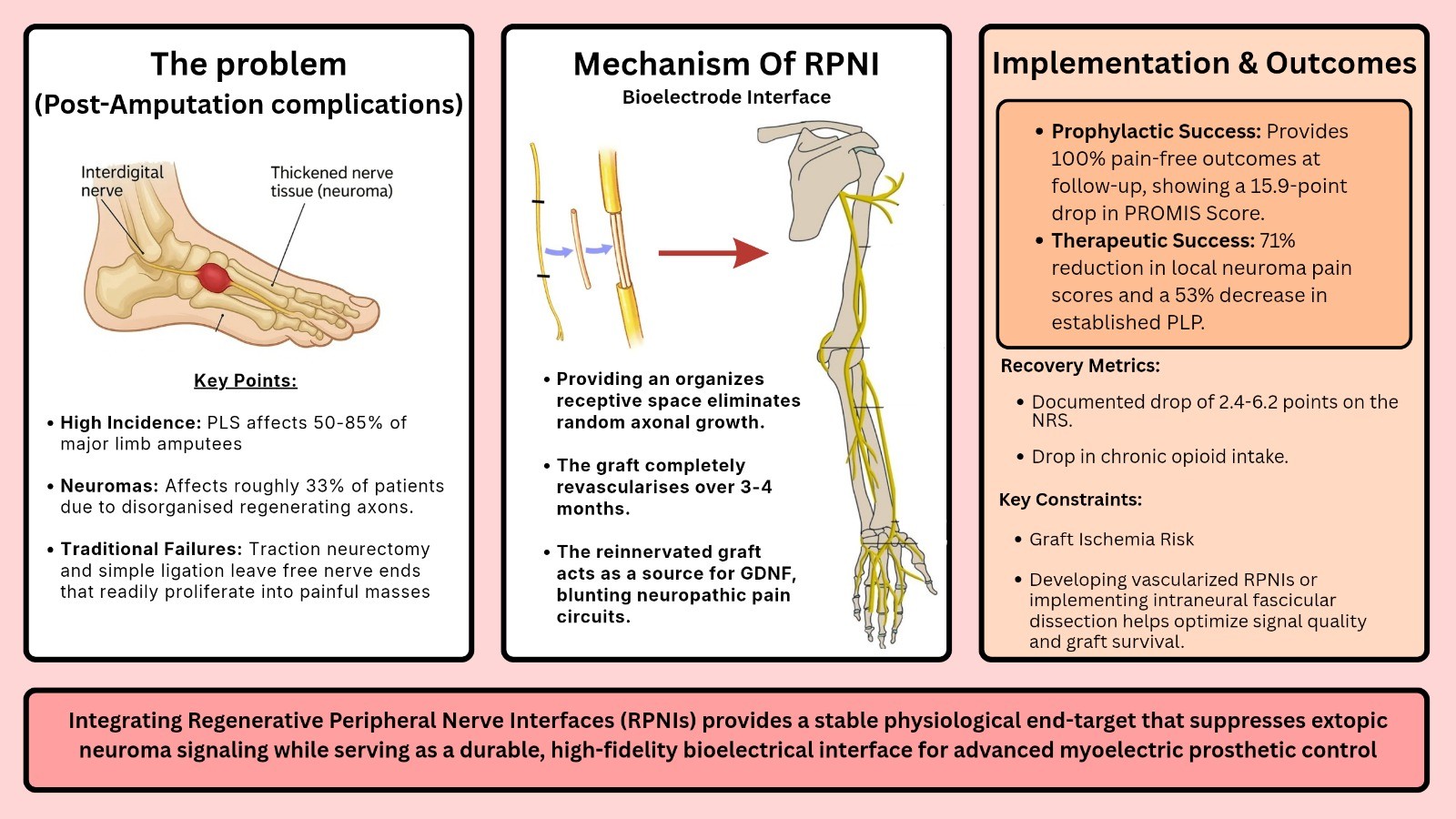
Graphical Abstract:
Reseach Highlights:
- Regenerative peripheral nerve interfaces provide a physiologic muscle end-target, effectively preventing disorganized axonal growth and neuroma formation.
- Clinical applications demonstrate significant reductions in post-amputation pain scores alongside decreased long-term opioid dependence.
- Prophylactic integration of muscle interfaces during primary amputation ensures superior long-term pain mitigation and functional recovery.
- The reinnervated muscle graft functions as a stable biological signal amplifier for high-fidelity myoelectric prosthetic control.
Type of Study: Review Article |
Subject:
Clinical Neuroscience
Received: 2025/05/25 | Accepted: 2025/07/20 | Published: 2025/07/30
Received: 2025/05/25 | Accepted: 2025/07/20 | Published: 2025/07/30
Send email to the article author
| Rights and permissions | |
 |
This work is licensed under a Creative Commons Attribution-NonCommercial 4.0 International License. |


.png)
